
Prošek vs Prosecco: two wines, two cultures, and one major misunderstanding
If you have ever heard the sentence in Croatia: “Oh, prošek – that’s like Prosecco?”, you are not alone. This confusion has existed for years, but in recent times it has become louder and more visible, largely due to political and legal disputes within the European Union. Although it is often perceived as a minor issue or a linguistic coincidence, it is in fact a much deeper problem involving tradition, history, wine culture, and identity.
At its core, the problem is simple: the names sound similar, but the wines themselves have almost nothing in common. They differ in style, production methods, historical development, and the way they are consumed. That is precisely why it is worth clearly and systematically explaining what Prošek is and what Prosecco is, which wines are truly comparable to Prošek, when each name first appears in historical sources, how Prošek is traditionally produced – especially from the Maraština grape variety – why a dispute arose between Croatia and Italy before the European Union, how tourists are often misled, and why “Prošek” from Slavonia sometimes has little to do with Dalmatian Prošek.
Prošek and Prosecco are not the same – and never have been
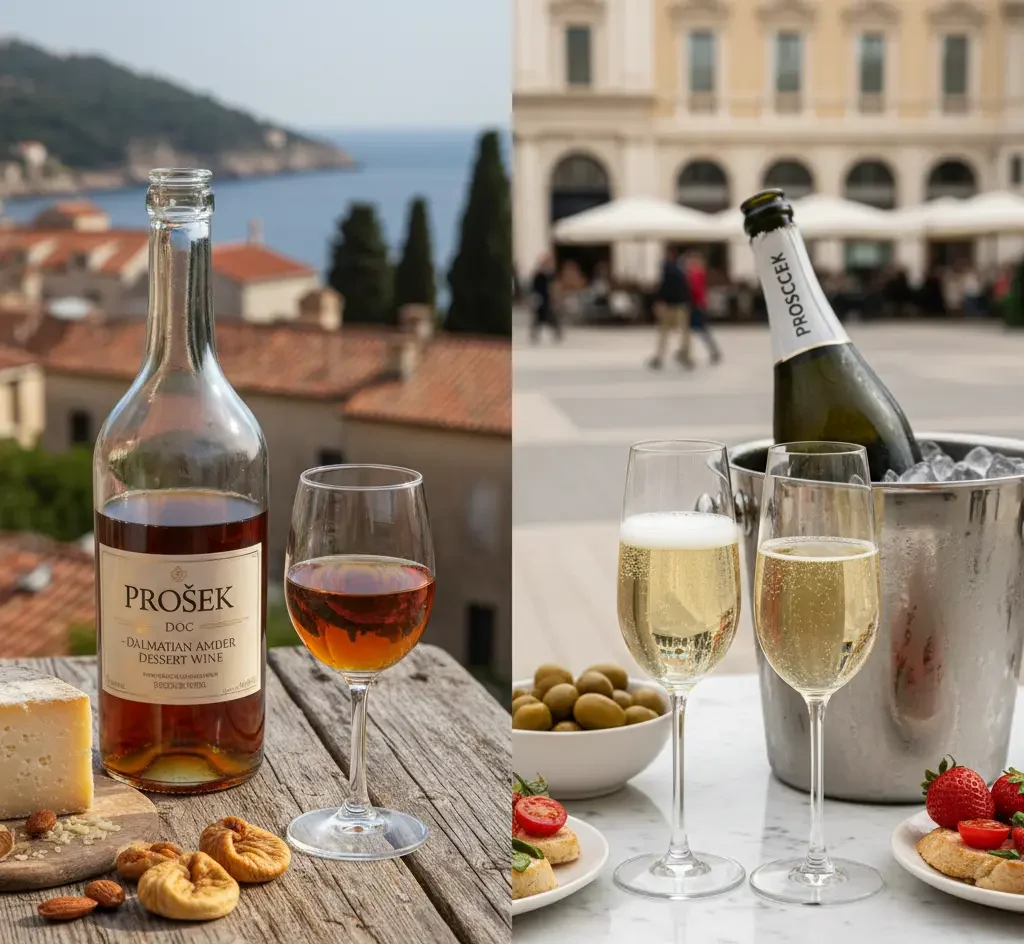
Prošek is a sweet dessert wine from Dalmatia, made from dried grapes. It is a wine that has traditionally been produced in very small quantities, often within families, without an industrial approach or mass production. Prošek is consumed slowly, in small glasses, most often at the end of a meal or on special occasions. Its key characteristics include the complete absence of bubbles, a high natural alcohol level that often ranges between 15 and 18 percent, pronounced density, natural sweetness, and oxidative notes that result from the method of production and ageing. This is not a wine intended as an aperitif, but rather for concluding a meal and for slow, deliberate enjoyment.
Prosecco, on the other hand, has almost nothing in common with this style. It is a sparkling wine from northern Italy, produced primarily from the Glera grape variety using secondary fermentation in tanks, known as the Charmat method. Prosecco is a light, fresh wine, most often dry or off-dry, with a lower alcohol content of around 11 percent. It is produced in large quantities and consumed as an aperitif or as a base for cocktails. Its role is social, light, and informal, while Prošek is concentrated, dense, and contemplative. The only thing they share is the phonetic similarity of their names.
Which wines are actually similar to Prošek?
If we are looking for wines that are technologically and stylistically similar to Prošek, then sparkling wines such as Prosecco are entirely irrelevant. Prošek belongs to the world of dessert wines made from dried or extremely ripe grapes. In this context, it is far closer to wines such as Port from Portugal, Sherry from Spain, Italy’s Vin Santo, various passito styles, or Commandaria from Cyprus. What all of these wines have in common is the use of overripe or dried grapes, a high concentration of natural sugars, and the fact that they are consumed slowly, in small quantities. If a comparison must be drawn, Prošek is, in both philosophy and style, far closer to Port than to Prosecco.
First historical appearances: which came earlier?
The name Prosecco was first documented in 1593 and originates from the village of Prosecco near Trieste. At that time, the wine referred to by this name was not sparkling. The sparkling style of Prosecco as we know it today developed only at the end of the 19th and the beginning of the 20th century, alongside the development of industrial methods for producing sparkling wines.
In the case of Prošek, the situation is significantly different. The practice of producing sweet wine from dried grapes in Dalmatia is much older, but the name “Prošek” itself appears less frequently in the earliest written documents. A key historical source can be found in the work of Petar Hektorović, “Ribanje i ribarsko prigovaranje” (1566), which mentions a sweet wine used in cakes and festive occasions. Although the modern term “Prošek” is not used, the description clearly points to a Dalmatian dessert wine made from overripe or dried grapes. Later, in 1774, Alberto Fortis describes Dalmatian sweet wines in his work “Viaggio in Dalmazia,” and during the 19th century the name Prošek enters broader and more formal use. From all of this, it follows that the production of Prošek itself is older, or at least equally old, as the first recorded appearance of Prosecco, even though the name Prošek was formalised later.
How Prošek is traditionally made (the example of Maraština)
One of the classic and historically important grape varieties used for the production of Prošek is Maraština, an autochthonous Dalmatian variety. The traditional process begins with a late harvest, when the grapes are extremely ripe. After harvesting, the grapes are dried in the sun or in well-ventilated spaces, sometimes for days and sometimes for weeks, concentrating sugars and aromas. This is followed by pressing the dried berries and a slow fermentation, often with the help of natural yeasts. After fermentation, the wine is left to rest for a long period, during which it develops complex aromas and structure. The result is highly concentrated sugars, natural sweetness without added sugar, and complex aromas of honey, dried fruit, and figs. More information about the Maraština variety and Dalmatian wine tradition can be found on the OPG Branko Marinov – Maraština page.
Croatia vs Italy: the dispute before the EU
The dispute between Croatia and Italy did not arise because of the wine itself, but exclusively because of the name. In 2009, Italy protected Prosecco as a geographical designation through the DOC and DOCG system. Croatia joined the European Union in 2013, at a time when the name Prošek had not yet been formally protected. The turning point occurred in 2021, when Croatia sought protection of the name Prošek as a traditional term, not as a geographical indication and not as a sparkling wine. The Italian side argued that consumers could be confused. The European Commission ultimately concluded that similarity of names alone is not sufficient, that the products differ in style, colour, alcohol content, and purpose, and that the name Prošek may be used as a traditional designation. Prošek did not “defeat” Prosecco; rather, it was protected from disappearing.
Tourists, confusion, and common scams
In practice, tourists in Croatia often order Prošek expecting a sparkling wine, or they purchase a product that has nothing to do with genuine Prošek. A particularly problematic situation arises when “Prošek” is sold at a price of 10 to 20 euros per litre, is available in large quantities, and appears light, thin, and lacking complexity. In such cases, it is very likely that the product is not true Prošek, but rather a wine with added sugar or a marketing label without a traditional production method. Genuine Prošek is produced in small quantities, has a significantly higher price per litre, and is consumed in small glasses, slowly and with respect for the time and effort invested in its production.
What about “Prošek” from Slavonia?
In Slavonia, wines sold under the name “Prošek” are sometimes wines from ice harvests or sweet wines obtained through late harvesting. Although these are often high-quality and respected wines, they are not Dalmatian Prošek and belong to a technologically and traditionally different category. It is more accurate to refer to them as ice wine or predicate wine, rather than Prošek in the original Dalmatian sense.
Conclusion
Prošek and Prosecco share only a similarity in pronunciation. Everything else – history, technology, culture, and purpose – is entirely different. Distinguishing between them is not a matter of nationalism, but of basic wine literacy.
Frequently Asked Questions – Prošek vs Prosecco
Is Prošek the same as Prosecco?
+
No. Prošek is a sweet dessert wine without bubbles, while Prosecco is a sparkling wine from Italy.
Why are these two wines so often confused?
+
Because of the similar names, even though historically, technologically, and stylistically they have almost nothing in common.
Which wines are closer to Prošek?
+
Port, Sherry, Vin Santo, and Passito styles – all wines made from dried or overripe grapes.
Is Prošek protected within the EU?
+
Yes, Prošek is protected as a traditional designation within the European Union.