
Buying domestic products today is more difficult than ever. The market is flooded with labels, marketing tricks, and products that promise one thing on the bottle and deliver something else inside. That is why more and more people are looking to buy directly from an OPG, where they know who stands behind the product, how it was made, and where it comes from.
In this guide, we answer the most common questions about olive oil, wine, rakija, and the philosophy of small-scale production—based on real experience, not theory.
OLIVE OIL
Purchase and Origin
1. Where can you buy real Croatian olive oil?
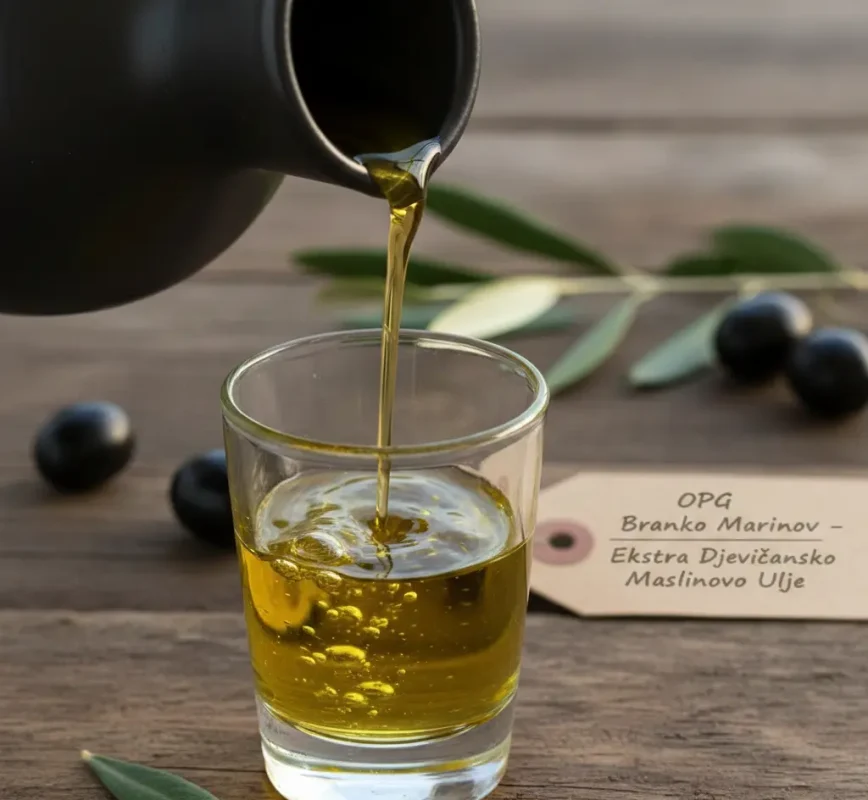
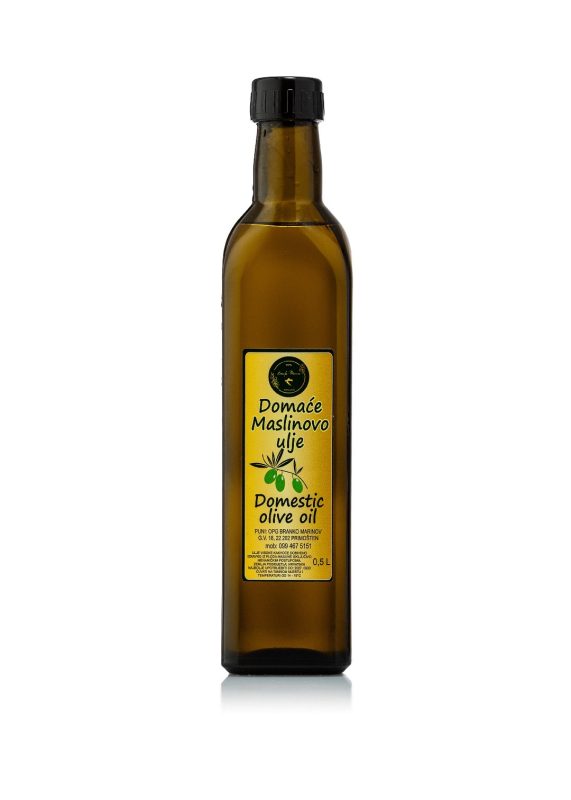
Real Croatian olive oil is best purchased directly from the producer who grows, harvests, and processes the olives themselves. At OPG Branko Marinov, the olives come exclusively from our groves in the Primošten hinterland, and the oil is produced in limited quantities without industrial compromises. By buying directly from an OPG, you know the exact origin of the oil, the harvest year, and the processing method—something that is increasingly rare today.
2. How can you buy olive oil directly from an OPG?
The purchase process is simple and adapted to modern buyers. Products are added to the shopping cart on our website, where you enter your contact details and delivery address. Payment is available via mobile banking, Google Pay, Apple Pay, or credit card, allowing olive oil to arrive directly from the producer to your home.
3. Is it worth buying olive oil directly from the producer?
Buying directly from the producer is always worthwhile because you are purchasing from the first link in the chain. We know every stage of production, from work in the olive grove to the storage of the finished oil. This type of purchase offers greater transparency, better freshness, and confidence in what you are consuming.
4. Where can you buy domestic olive oil in Dalmatia?
During the summer season, domestic olive oil can be purchased at our stand, where you can personally taste the product and speak with the producer. If you are unable to visit in person, olive oil is available year-round through our website. In this way, traditional local sales are combined with modern accessibility.
5. What is the difference between olive oil from an OPG and store-bought olive oil?
Olive oil from an OPG is not an industrial product and is not made by blending oils of different origins. Every stage of production is under our control, and laboratory analysis confirms that the oil is extra virgin. Store-bought oils are often standardized products with unclear origin and no distinct identity.
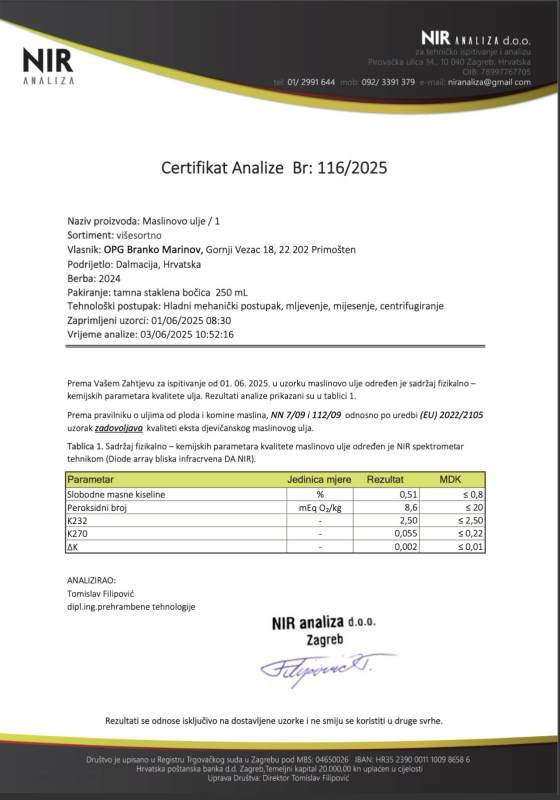
Official laboratory analysis certificate showing quality standards for those learning how to buy domestic olive oil directly from the producer.
Quality and Authenticity
6. How can you recognize real extra virgin olive oil?
Real extra virgin olive oil has a fresh, pronounced aroma of olives, grass, or green fruit. The taste may be slightly bitter and peppery, which indicates the presence of natural polyphenols. Color can vary, but color alone is not a decisive indicator of quality.
7. Why is olive oil often adulterated?
Olive oil is relatively easy to adulterate because blending with other oils is difficult to detect using standard analyses. Market controls are often insufficient, and common methods such as freezing are unreliable. This is why it is important to buy from a trusted producer.
8. Is domestic olive oil better quality than industrial olive oil?
In most cases, domestic olive oil is of higher quality because it is produced in smaller quantities and does not need to sit on shelves for long periods. Industrial oils are often adapted for long storage, which affects freshness and flavor. With domestic producers, the focus is on quality rather than quantity.
9. What does it mean when olive oil is cold-pressed?
Cold pressing means that the oil is extracted at temperatures below 27°C. This process preserves natural aromas, antioxidants, and nutritional value. Higher temperatures yield more oil but reduce quality.
10. How important is it that olives are processed on the same day?
Olives that are not processed on the same day begin to ferment quickly, which negatively affects the oil’s taste and aroma. Same-day processing is essential for preserving freshness and quality. That is why olives are transported for processing immediately after harvest.
Production
11. How is olive oil produced on a small OPG?
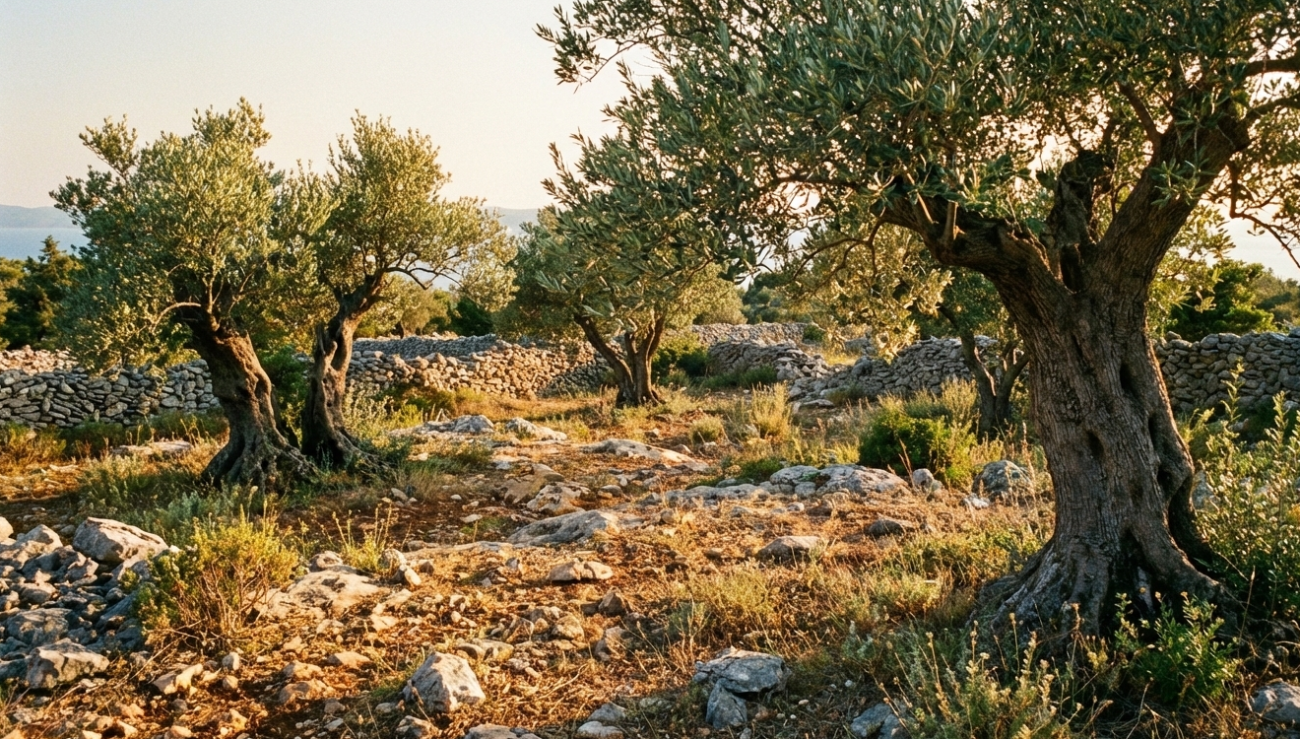
Olive oil production begins with year-round work in the olive grove, including fertilization, pruning, and mowing. Harvesting is done carefully to keep the fruit intact. Olives are processed on the same day to preserve oil quality.
12. How much olive oil does a small producer make per year?
Small producers typically produce up to one thousand liters of olive oil annually. At OPG Branko Marinov, production is intentionally limited and not planned to increase. Smaller quantities allow greater control and consistent quality.
13. Why don’t small producers increase production?
Increasing production often reduces control over the process. Larger volumes require faster processing and greater compromises. Choosing to remain small is based on the desire to preserve quality.
14. Is hand-harvesting olives better than mechanical harvesting?
Hand harvesting allows for more careful selection of fruit and less damage to the olives. However, the most important factor is the speed of processing after harvest. Regardless of harvesting method, olives must be processed as soon as possible.
15. How do climate and soil affect the flavor of olive oil?
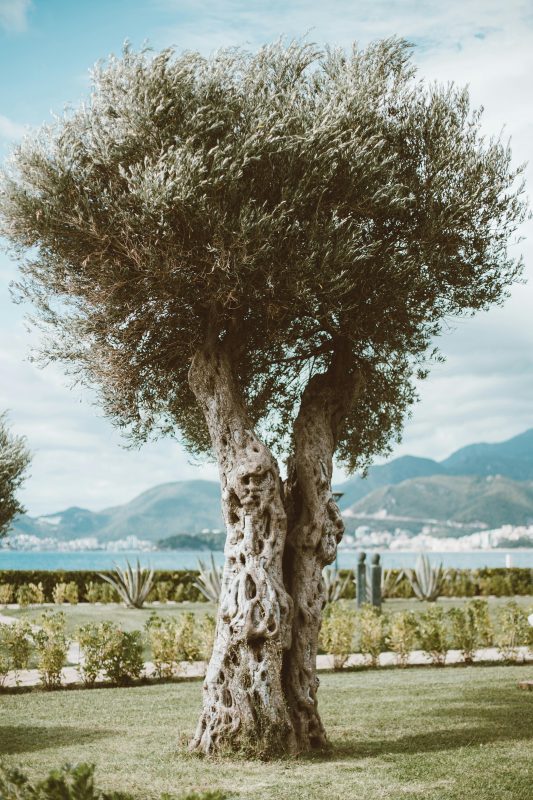
Climate, sunlight, and soil type directly affect the character of olive oil. Rocky soils and the dry Dalmatian climate produce oils with more intense aroma and peppery notes. Each olive grove has its own distinctive profile.
WINE
16. Where can you buy domestic wine directly from the producer?
Domestic wine is best purchased directly from the winemaker, either at a stand or through the producer’s website. During the summer, many small producers along the coast offer wines with strong character. Buying directly provides better insight into the wine’s origin.
17. How is wine produced on a small family farm?
Wine production begins in the vineyard with year-round care of the vines. After harvest, fermentation follows, along with several rackings and constant monitoring of parameters such as acidity and SO₂. Everything is done with minimal intervention to preserve the wine’s natural character.
18. How does domestic wine differ from industrial wine?
Domestic wine is not standardized to taste the same every year. Industrial wines are often heavily processed to ensure uniformity. Domestic wines reflect the character of the vintage and the terroir.
19. Is natural wine healthier than commercial wine?
Wine contains alcohol and cannot be considered healthy. However, wines with fewer interventions are often easier to drink and provide a more authentic experience. Moderation is key.
20. Why do small wines have a different character?
Small wines are produced without the pressure of mass production. Each harvest and each barrel has its own personality. This diversity gives small wines their distinctive character.
RAKIJA
21. Where can you buy real domestic rakija?
Real domestic rakija is purchased directly from the producer, either at a stand or through a website. This way, you know exactly what it is made from and how it was distilled. Direct purchase ensures transparency.
22. How is traditional Croatian rakija produced?
Rakija is produced by distillation in a copper still. Pomace, must, or wine is heated over fire, alcohol evaporates, and then condenses through a pipe cooled with water. The resulting distillate is then left to rest.
23. What is the difference between domestic and industrial rakija?
Industrial rakija is often made by diluting ethyl alcohol and adding aromas. Domestic rakija is produced exclusively through the distillation of fruit or wine. The difference is clearly noticeable in aroma and taste.
24. Which fruit is used to produce quality rakija?
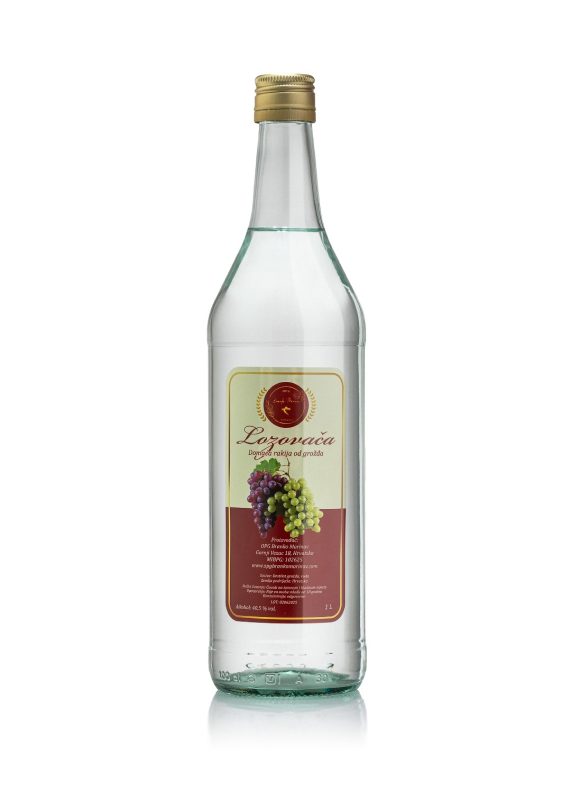
Quality rakija can be made from almost any fruit. In Dalmatia, grape rakija (loza) is most common, while plum rakija dominates in Slavonia. At our OPG, we also produce sour cherry and walnut liqueurs, with grape rakija as the base.
OPG AND PHILOSOPHY
25. Why buy food directly from an OPG?
Buying directly from an OPG provides greater security and trust in the product. When you know the producer, you know how the food was made. It also supports the local community and family farming.
26. What does small, limited food production mean?
Small production means full control over the process, without rushing or compromise. Every product has a known origin and a clear story. Quantity is limited because quality comes first.
27. Is quality more important than quantity in food production?
Quality is more important than quantity in the long term. Large industries focus on profit and volume, while small producers build trust through quality. That trust makes the difference.
28. What is life like on a family farm?
Life on an OPG is peaceful but physically demanding. Workdays are long, and the work lasts all year. Despite this, the connection to nature and pride in one’s own products bring fulfillment.
29. Why don’t small producers engage in mass production?
Mass production requires changes that often affect product quality. Small producers choose to remain faithful to their values. Quality over quantity remains the foundation of their philosophy.